

A Shared Journey
Born and raised in Brazil, freshmen Beatriz Faria and Giovanna Veronese came to the United States to experience American culture while receiving their degrees, B in marketing and G in Business. For the pair, studying abroad in the United States has always been a dream, and now it has become a reality, and they are doing it together.
I recently had the opportunity to talk with Faria and Veronese about their home country, Brazil, and the differences between our countries. Here are 3 of my biggest takeaways from our conversation:
1. Difficulty with the language and cultural barrier
Outside of basic English classes in school and private classes, Faria and Veronese took different paths in learning the language as they grew up. Faria began learning the language at age 8 through private lessons, and Veronese started at age 13 with two years of private lessons and speaking English with her uncle, who is American. Despite both of them having learned basic English in school and taking private lessons in their spare time, there was still a greater language barrier than they expected.
“I didn’t think it would be, but it is, because every time I’m speaking in English, I have to really think about what I’m saying to translate things, and it’s always like I’m doing math in my mind to speak,” said Veronese. “And I do think that someday it will become natural and I won’t have to think about it to speak.”
While some trouble speaking a different language every day is to be expected, many people don’t take cultural differences into account. American references, especially in modern-day culture, are very different from Brazil, so there is often a disconnect.

2. Positive international student experience at Maryville
According to Maryville University’s website, the University has over 200 international students on its campus, representing 57 different countries. Given our vast global community, it’s important for the University to accommodate and support these students as they transition into campus life. Based on Faria and Veronese experience, groups like the Maryville University International Committee have been very helpful during this transition.
“The international students committee really pays attention to us and tries to help us with everything. They helped us create a bank account and get our number,” said Veronese. They’ve been really helpful. I feel like they’re really welcoming.”
Outside of the international student committee, it’s also essential for international students to have support from the rest of the school’s students and faculty. It can be hard to connect with other students outside this “international student bubble” due to cultural differences or language barriers. Based on Faria and Veronese experience with this difficulty, individuals at our institution have been very understanding.
“[It’s] not only the students and the international students, but the staff too, like the teachers. I really like them, and they helped me because I told all of them that I’m an international student, so they know, and they try to help me the best way they can, which I’m glad about,” said Faria.
3. The education style is very different from our own
Public universities in Brazil are highly competitive, and admission depends on an entrance exam. Because of this, high schools are highly focused on the college entry exam. According to Faria and Veronese, if you don’t score well, you don’t go to college.
“You have to take a test. It is a college entrance exam, and that’s the only thing they use to see if you’re going to college or not. You just have to take the exam; if your grade is good enough, you get in; if it’s not, you don’t,” said Veronese.
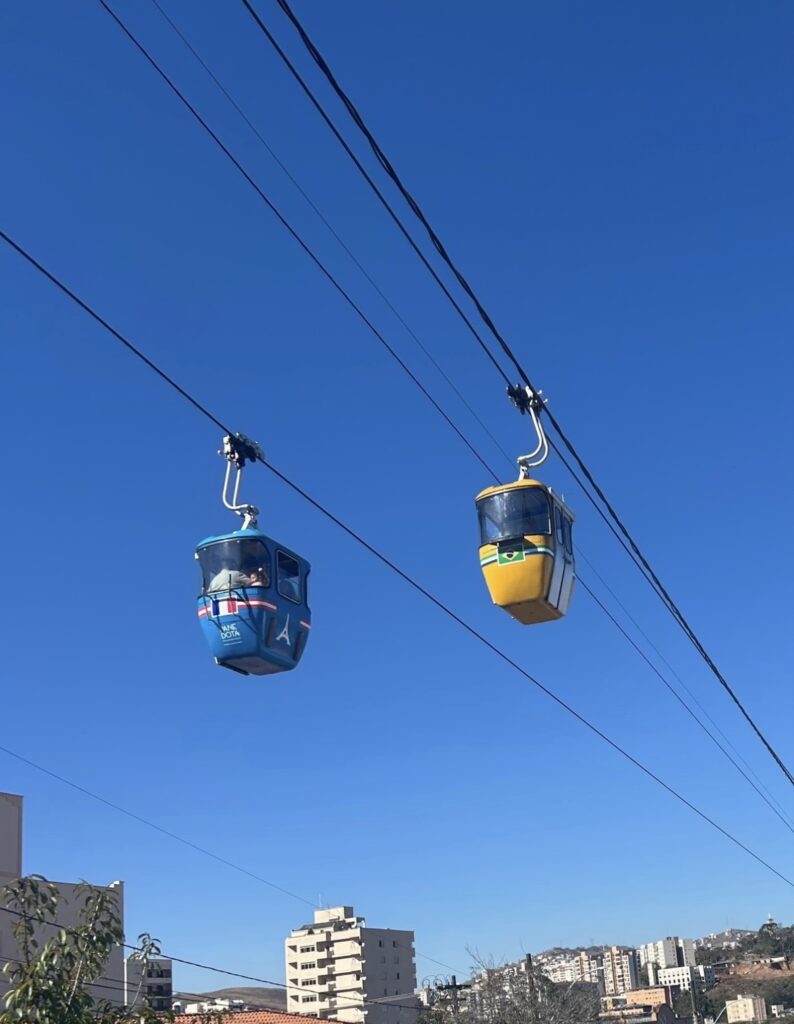
Cable cars in Brazil. Photo courtesy of Beatriz Faria and Giovanna Veronese.
A comparable test in the US for college is the ACT or the SAT. Still, now, most universities, both public and private, don’t require either and focus more on a student’s overall GPA and extracurricular activities. In Brazil, the test dictates the future of their education. Despite being able to retake it to improve your score, there is a lot of pressure to do well for your future, and your high school emphasized that.
“We used to like mock tests, almost every Saturday, and it’s about 90 questions for these mock exams,” said Veronese.
Advice for future international students
One of the first things I asked Faria and Veronese was what their favorite part about the US was, and it was “almost everything,” so it was safe to say that any difficulty or stress getting here was worth it. Hearing about their experiences getting here, I wanted to know if there was any advice for those considering becoming international students or for those who are current international students, and these were their responses:
“This thought comes to mind, like, throughout the college application process, it’s just so hard because we’re always writing a lot of essays and working on our college list and trying to write essays in English when we don’t actually know how to write essays in English. And we’re always anxious about thinking that we don’t have enough extracurriculars or that our SAT [score] is not high enough, Said Veronese. But it will work out; everything will work out. It does have to keep trying and trust the process.”
“I feel like I would tell new students to not stay in their comfort zone, because it is going to be hard. You have to try new things,” Faria said. “You’re going to doubt yourself a lot of times: ‘I don’t think my score is high enough, I don’t think I’m going to make it.’ I always thought that during this process, but I kept going, and now I am here.”

 Share


